
Leander Elite Concrete installs stamped concrete in Leander, TX and throughout nearby cities including Cedar Park, Georgetown, Lakeway, Brushy Creek and Steiner Ranch, drawing on more than 20 years of decorative and structural flatwork in Central Texas. Stamped concrete puts a pattern and a color into a slab while it is still plastic, so the texture is part of the concrete rather than a covering laid over it.
That is the whole argument for it. A stamped patio, walkway or pool surround gets the look of stone, brick or timber from a single monolithic pour, with no joints for weeds to find and no individual units to settle out of plane. What it asks in return is a higher standard of execution, because the pattern goes in during a window of a few hours and cannot be adjusted afterward.
It also has to be quoted honestly. A stamped surface is the pattern plus the color system plus the release agent plus the sealer, and a bid that leaves the sealer out is not cheaper, it is missing a line you will pay for later along with the reseal cadence that follows it. We quote all four together and tell you what maintaining the finish will involve before you choose it.
Patterns, Textures and Layout
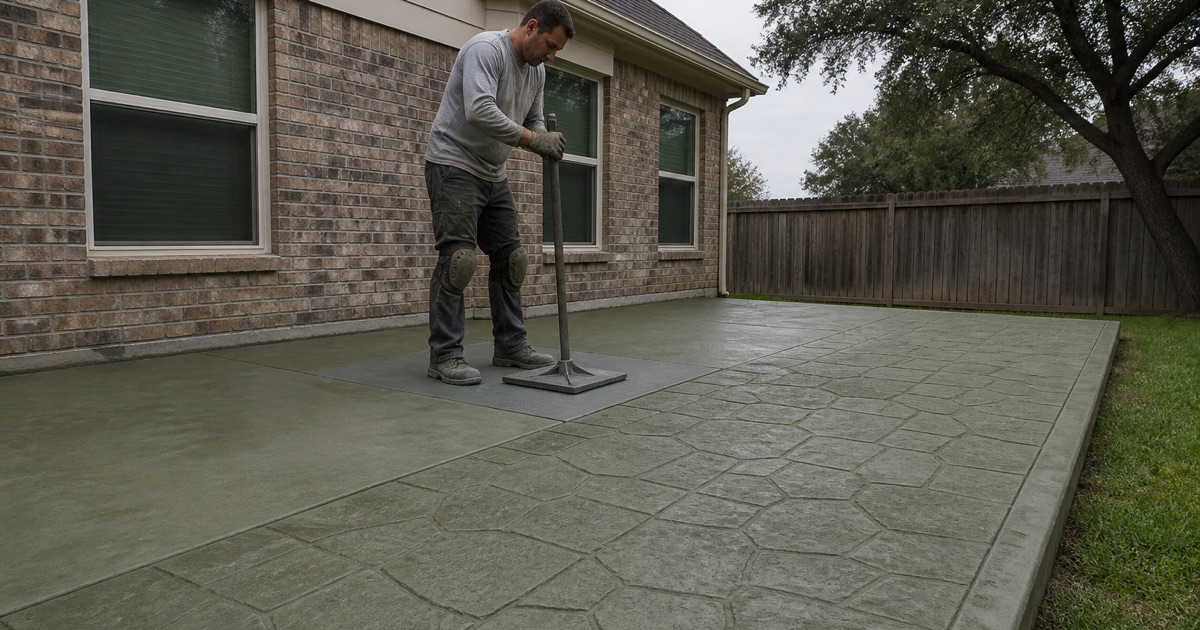
Stone, Slate and Ashlar Patterns
Stone and slate patterns are the most forgiving choices for a large area because their irregular texture hides the small variations that any hand-worked surface carries, and ashlar cut patterns give a more formal, tailored result on a patio or entry. We lay the pattern out from a starting line that keeps full units in the most visible areas rather than starting at a corner and finishing with slivers. Where a pattern meets a step or a curve, that planning is the difference between deliberate and improvised.
Brick, Cobble and Running Bond
Brick and cobble patterns read at a smaller scale and suit walkways, borders and entries where the eye is close to the surface. A running bond laid parallel to the direction of travel makes a narrow walk look longer, and laid across it makes a wide patio feel wider. We choose the orientation with the space rather than defaulting to whatever direction the pour happens to run, since the pattern will be there for the life of the slab.
Wood Plank and Large Format Textures
Wood plank stamps give the appearance of timber decking without the rot, splinters or annual sealing that real boards ask for, and large format textures suit contemporary houses where a busy pattern would fight the architecture. Both are less tolerant of layout errors than random stone, because a plank running out of parallel is immediately visible. We dry-lay the pattern before the pour on any job where the geometry is unforgiving.
Color, Sealer and Long-Term Appearance
Integral Color, Color Hardener and Antiquing
Integral color is mixed through the concrete so it runs the full depth, while color hardener is worked into the surface and gives a denser, more wear-resistant top layer with stronger color. An antiquing release agent adds the secondary tone that stops a stamped surface reading as one flat shade. We usually combine them, because a single-color stamp is the most common reason a finished patio looks less convincing than the sample did.
Choosing a Color That Holds Up Under Texas Sun
Every exterior color shifts with exposure, and the ones that shift least are those carried through the concrete rather than sitting on it. We show weathered samples alongside fresh ones so the choice is made against what the surface will look like in a few years, not on the day it is poured. Very dark colors also run considerably hotter underfoot in August, which matters more on a pool deck than on a front walk.
Sealers and the Reseal Cadence Nobody Mentions
A film-forming sealer gives stamped concrete the wet, saturated look most people picture and wears off in traffic paths, while a penetrating sealer protects with far less appearance change and much less maintenance. Neither is permanent. We tell you the reseal interval for whichever we apply, and we would rather you choose a lower-sheen finish you will actually maintain than a high-gloss one that looks patchy in three years.
Where Stamped Concrete Works, and What It Needs Underneath
Patios, Entries and Walkways
Patios and entries are where stamped concrete earns its keep, since they are seen constantly, take moderate loads and benefit from a continuous surface with no unit joints. We build them on the same base and jointing standards as any structural flatwork, because a decorative surface over a poor subgrade is a more expensive failure than a plain one. Control joints are laid out to align with pattern lines wherever the geometry allows.
Pool Decks and Slip Resistance
Around a pool the finish has to stay grippy when wet and stay tolerable barefoot in summer, and those pull in opposite directions. We adjust texture depth and add a slip-resistant additive to the sealer rather than relying on the stamp alone, and we steer clients away from the darkest colors in that location. The sealer choice changes slip resistance at least as much as the pattern does.
Driveways and the Extra Demands of Vehicle Load
Stamped concrete works on a driveway, but it is a structural slab first and a decorative surface second, so thickness, reinforcing and base all follow driveway standards rather than patio ones. Inside the right of way the approach still has to meet the adopted detail and its uniform two percent slope. We build the structural half to that standard and treat the pattern as what it is, a finish applied to a slab that has to carry vehicles.
Our Step-by-Step Stamped Concrete Process
1. Layout, Sample Selection and Written Scope
We walk the space with you, set the shape and the elevations, and choose the pattern, the color system and the sealer against weathered samples rather than fresh chips. That scope goes into a written proposal naming all four components, so the number you compare against another bid covers the same work. Deciding the pattern orientation and the starting line at this stage is what keeps full units in the areas you look at most.
2. Excavation, Base and Reinforcing
Decorative concrete needs the same structural preparation as any other flatwork, so we strip and correct the subgrade, compact it to a verified standard, place base and set steel on chairs off the ground. Where limestone has to come out it comes out mechanically with a hydraulic breaker or a rock saw, since blasting is prohibited in Leander. A stamped surface over a poor base is simply a more expensive slab to replace.
3. Placement, Coloring and Stamping
On pour day the sequence is fixed by the concrete, not by the crew: place, screed, apply color hardener where specified, float, then stamp within the window while the slab is still plastic. We bring enough hands to stamp the whole area inside that window rather than working across it in stages, because a surface stamped at two different stages of set shows the join permanently.
4. Joint Cutting, Cure and Sealing
Control joints are cut with an early-entry saw on a spacing matched to the slab and aligned with pattern lines wherever the geometry allows, then the surface is cured before any sealer is applied. Sealing too early traps moisture and clouds the finish, so this is one of the few points in the job where waiting is the skilled decision. We give you the sealing date and the first reseal interval together.
- 20+ Years in Concrete
- Licensed & Insured
- Free Estimates