Leander Elite Concrete provides concrete leveling in Leander, TX and the surrounding cities including Brushy Creek, Georgetown, Cedar Park, Round Rock and Liberty Hill, backed by more than 20 years of work on the ground conditions that make slabs drop here in the first place. Leveling raises a settled slab back to where it belongs without removing it, and when the cause underneath has genuinely been dealt with, it is the cheapest durable answer to a sunken driveway, walk, patio or garage floor.
The word people usually reach for is sinking, but concrete does not sink. It stays where it was placed until the support beneath it goes, and then it follows the ground down. That distinction decides the whole job: the concrete is rarely the defective part, and lifting it without addressing the void, the erosion or the compaction that opened is a repair with a short and predictable life.
Around Leander the causes cluster. Deep shrink swell clay across much of the city pulls away from the underside of a slab in a dry spell and returns unevenly when it rains, poorly compacted fill under an approach or a garage transition consolidates under traffic, and downspouts and roof runoff cut channels under flatwork that nobody sees until an edge drops. We identify which of those produced your settlement before we lift anything.
Residential Concrete Leveling
Driveway and Garage Transition Leveling
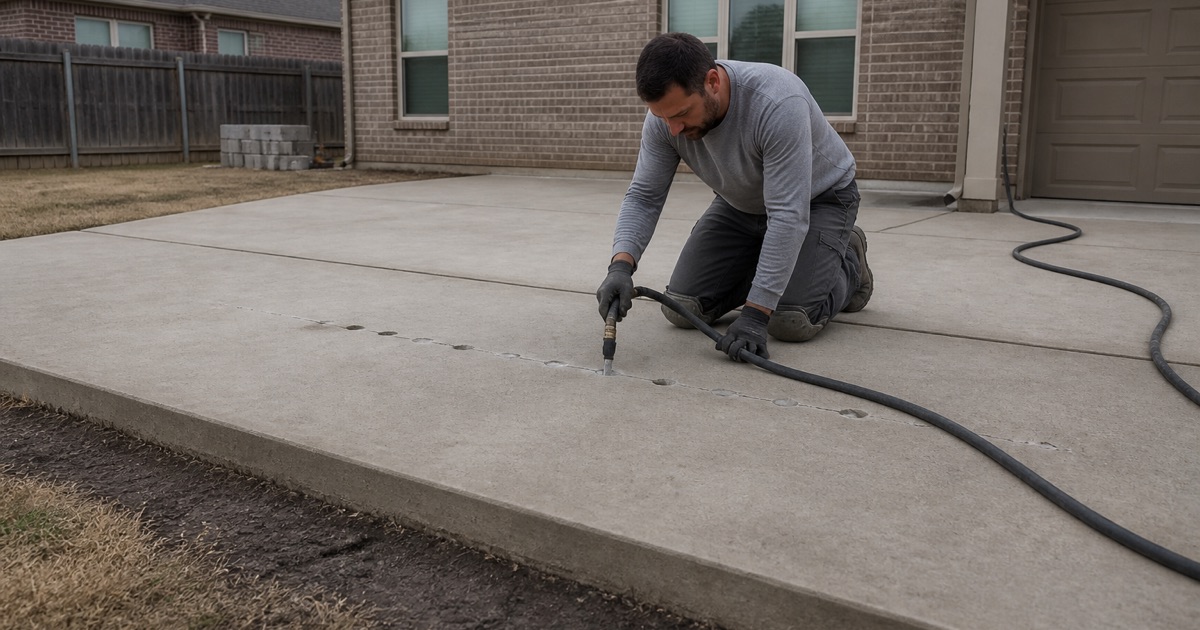
A driveway that has dropped at the garage or at the street is the most common leveling job we take, and it is worth doing early because the slope that develops sends water toward the structure rather than away from it. We lift the panels back to a grade that drains, fill the space we raised them out of, and reseal the isolation joint between the driveway and the garage slab. Left alone, that dropped edge becomes both a water problem at the foundation and a slab that eventually cracks across the unsupported span.
Sidewalk, Walkway and Porch Leveling
Settled walk panels create trip hazards at the joints and often pond water in the middle of a run, and both are fixed by returning the panel to plane rather than by grinding the high side down. We lift individual panels so the run reads level end to end, which grinding cannot deliver once the drop is more than modest. A porch or stoop that has pulled away from the house is the same repair with more care, since the void under it is usually deeper than it appears from the edge.
Patio, Pool Deck and Backyard Flatwork Leveling
Backyard flatwork settles for its own reasons, usually irrigation, roof runoff or a slab poured over fill that was never properly compacted, and around a pool the consequences arrive faster because water is delivered to the same spot daily. We lift patios, pool decks and coping-adjacent panels back to a positive fall away from the house and the pool shell. Getting the fall right is most of the value; a level patio that drains toward the structure has solved the cosmetic half of the problem only.
Commercial Concrete Leveling
Warehouse and Interior Slab Leveling
An interior slab that has settled at a joint or a doorway is a forklift and pallet-jack problem long before it is a cosmetic one, and shutting a building down to remove and replace the panel is rarely proportionate. We lift interior slabs in place, working around racking and traffic lanes, which returns the floor to service the same day in most cases. Slab grinding handles the localized high spots that lifting cannot address on its own.
Parking Lot, Approach and Loading Area Leveling
Commercial approaches, drive aisles and loading areas settle where the heaviest wheel loads track the same path, and the resulting depressions collect water that accelerates the failure underneath them. We fill the voids and lift the panels back to a grade that drains to the intended point rather than pooling mid-aisle. On a reconstruction we keep at least half the driveway open at all times, which is what the specification requires and what keeps a tenant’s customers arriving while we work.
Choosing Between Foam, Mudjacking and Grinding
Polyurethane Foam Lifting
Polyurethane foam lifting injects an expanding polymer through small ports, filling the void and raising the slab in a controlled way with very little added weight on the soil beneath. It sets quickly, so traffic returns fast, and the small injection holes patch discreetly. We use it where the underlying soil is weak enough that adding mass would be counterproductive, and where getting the surface back into service quickly matters more than the cost per hole.
Mudjacking and Slurry Lifting
Mudjacking pumps a cementitious slurry under the slab through larger ports, filling the void with a heavier and less expensive material than foam. It suits slabs over reasonably competent ground where the added weight is not a concern and the budget matters more than the hole size. We are direct about the trade-off rather than steering every job to one method, because the right choice is set by what is under the concrete, not by the equipment on the truck.
Slab Grinding and When Not to Lift
Sometimes the correct answer is to take the high side down instead of raising the low one, particularly for a small trip hazard on a walk or an interior transition where headroom or a door swing is fixed. We grind those to a compliant slope rather than lifting a panel that is otherwise sitting fine. And where the slab itself has broken into pieces that rock underfoot, we say plainly that leveling is the wrong tool and replacement is the honest recommendation.
Our Step-by-Step Concrete Leveling Process
1. Measuring the Settlement and Finding the Cause
We measure how far the slab has dropped and in which direction it is now falling, then look for the cause: erosion paths, downspout discharge, irrigation, poor original compaction or clay shrinking away in a dry spell. Lifting a slab without naming that cause guarantees a return visit, so the assessment is where the real decision gets made.
2. Correcting the Water Before the Concrete
Where runoff or irrigation is washing out support, we address it or tell you exactly what needs addressing before we lift. Concrete leveling that leaves the water doing what it was already doing is a temporary result at full price, and the fix outside the slab is usually far cheaper than the second lift would be.
3. Port Layout and Injection
Ports are drilled on a pattern matched to the slab’s size, thickness and the shape of the void, then material is injected in stages so the lift stays controlled and even. We monitor the slab as it moves rather than raising it in one push, because lifting too fast in one location is how a sound panel gets cracked during a repair meant to save it.
4. Joint Reset, Patching and Load Return
Once the panel is at grade, we patch the ports, reset the isolation and control joints that moved, and reseal them so water and debris stay out of the space beneath. We then give you a specific time for foot traffic and vehicle load, which with foam is usually the same day and with a slurry lift is longer.
- 20+ Years in Concrete
- Licensed & Insured
- Free Estimates