
Leander Elite Concrete installs decorative concrete in Leander, TX and across nearby cities including Georgetown, Cedar Park, Lakeway, Round Rock and Liberty Hill, drawing on more than 20 years of work where the finish and the structure are the same slab. Decorative concrete is not a covering applied to a floor; it is a set of decisions taken while the concrete is still plastic, or reactions taken into a slab that already exists.
That timing is what separates it from most finishes. A pattern goes in during a window of a few hours on pour day and cannot be reconsidered afterward, and a stain reacts with what is in the slab rather than covering it. We spend the planning time up front, with samples you can look at outdoors, because the decisions become permanent very quickly.
Color and Surface Treatments
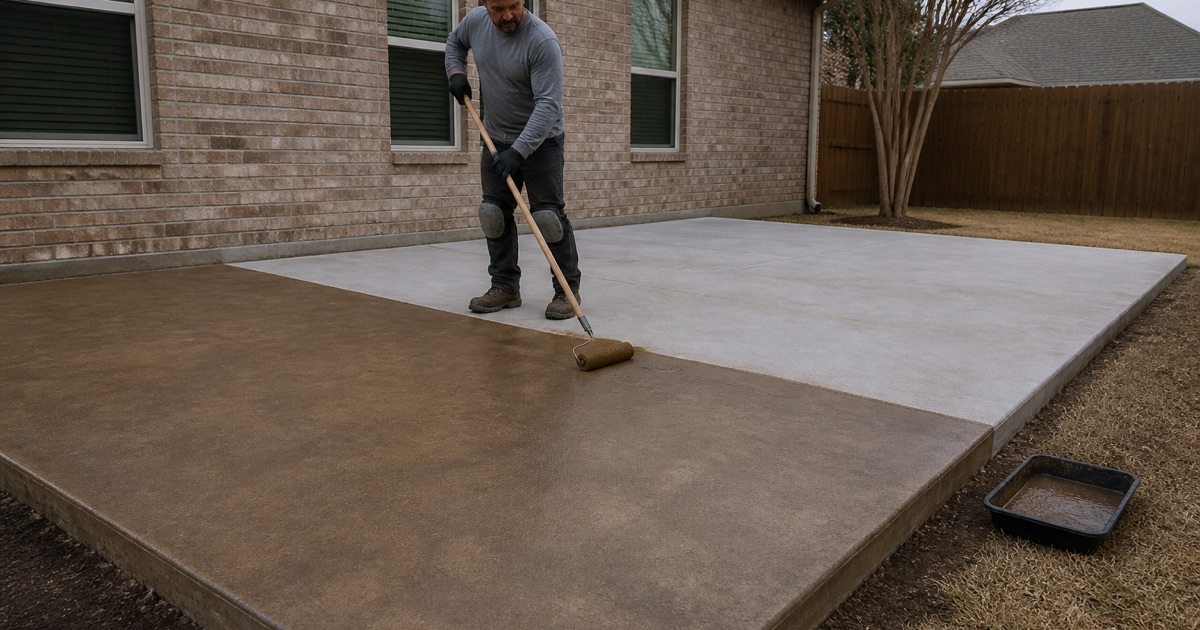
Integral Color and Color Hardener
Integral color is mixed through the concrete so it runs the full depth and weathers far more gracefully than anything sitting on the surface, while color hardener is worked into the top and produces a denser, more wear-resistant layer with stronger color. We often combine the two. Color carried into the concrete is what still looks deliberate after several Texas summers rather than washed out.
Acid Stain and Water-Based Stain
Acid stain reacts chemically with the concrete and gives variegated, translucent results that no two slabs repeat exactly, while water-based stain deposits pigment and offers a wider, more predictable color range. Both need a clean, sound slab with no old film-forming sealer on it. We test a hidden area first, since a contaminated or inconsistent slab takes color unevenly no matter how carefully it is applied.
Dyes, Antiquing and Layered Color
Layering is what stops decorative concrete reading as one flat tone: an antiquing release agent during stamping, a secondary dye, or a second stain color worked selectively. We build that depth deliberately rather than applying a single color and hoping the texture carries it. A single-tone decorative surface is the most common reason a finished job looks less convincing than the sample it was chosen from.
Texture, Pattern and Aggregate
Stamped Patterns and Layout
Stamped patterns give the appearance of stone, brick, slate or timber in a single monolithic pour, with no unit joints for weeds and no separate pieces to settle. Layout is what makes them convincing, so we start the pattern from a line that keeps full units in the areas you look at most rather than beginning in a corner. Control joints are aligned to pattern lines wherever the geometry allows.
Exposed Aggregate and Gradation
Exposed aggregate ranges from washing the paste off a standard mix to specifying the stone under ASTM C33 and designing the appearance around it, and the second is a genuinely different product from the first. We tell you which one a price describes. Selected aggregate costs more and reads far better, and the two are frequently quoted as if they were the same thing.
Broom, Salt and Trowel Textures
Texture is a decorative choice and a safety specification at the same time. A broom finish gives directional grip, a salt finish gives a fine open texture that suits wet areas, and a hard trowel finish belongs indoors where it is polished and protected. We match the texture to where the surface is and how wet it gets, rather than choosing purely on appearance.
Overlays and Existing Slabs
Bonded Overlays and Microtoppings
Where a slab is structurally sound but worn or dated, a bonded overlay or a microtopping can carry new color, texture or a stamped pattern without replacement. Surface preparation is most of the work and most of the risk. We test adhesion before committing, because an overlay on a slab that is still losing its top layer simply buries the failure under something newer.
Polishing and Interior Finishes
Interior slabs can be mechanically polished to varying levels of gloss and aggregate exposure, giving a hard, low-maintenance floor that is the structure rather than a covering on it. What decides the result is the slab: its flatness, its aggregate and how well it was placed. We assess an existing floor honestly before selling a polish, because the concrete’s own history is visible in the finished surface.
Repair, Recolor and Reseal
Older decorative work often needs less than owners expect: cracks routed and filled, a section recolored and the whole surface stripped and resealed can restore a great deal. We start with the least invasive option that will actually work. Replacing decorative concrete that only needed maintenance is expensive, and stripping a failed sealer is usually where the improvement actually comes from.
Sealers, Wear and Keeping It Looking Right
Penetrating and Film-Forming Sealers
A penetrating sealer soaks in, protects and changes appearance very little, while a film-forming sealer gives the saturated, wet look most people picture and wears off in traffic paths. Neither lasts forever. We explain the trade-off in terms of maintenance rather than appearance alone, because the finish that photographs best is often the one that needs the most attention.
Traffic, Sun and How Surfaces Age
Decorative concrete ages differently depending on exposure: a south-facing driveway, a shaded side entry and a covered patio will not look the same after several years even if they were poured together. We factor exposure into the specification for each area. Choosing one finish for an entire property because it looked right in one location is how a job ends up mismatched.
Cleaning and What Damages a Finish
Most damage to decorative surfaces comes from routine things: de-icing chemicals, fertilizer spills, pressure washing at too close a range, and sealers applied over a surface that was not clean. We hand over specific care instructions for the system installed rather than generic advice. A finish maintained correctly for the first few years generally keeps its appearance well beyond that.
- 20+ Years in Concrete
- Licensed & Insured
- Free Estimates