Concrete Contractor in Leander, TX

Driveways, slabs, patios and commercial flatwork placed by a crew that prices the rock and handles the permit before the first truck arrives.

Leander Elite Concrete has placed, repaired and replaced concrete across Leander, TX for more than 20 years, covering driveways, slabs and pads, patios, pool decks, sidewalks, retaining walls, decorative finishes and commercial flatwork. We work the whole job rather than one slice of it, from the first look at what is under your lot through the permit packet, the forming and steel, the pour itself and the day the surface is ready to carry a vehicle.

Most of what separates concrete that lasts from concrete that fails is decided before a truck arrives. The subgrade, the cushion under the slab, where the steel sits, where the joints fall and how the surface is cured are all set in the first two days of a job, and none of them is visible once the work is finished. We tell you what we are doing at each of those points and why, because that is the part of the price you cannot inspect later.

The other half of the work here is procedural. A driveway in this city is a plan reviewed permit rather than a counter transaction, blasting is prohibited outright, and the approach inside the right of way is built to a published detail with a slope the city will make a contractor rebuild if it is wrong. We handle that side as part of the job, not as a surprise that arrives after you have signed.

Get Your Free Quote

Fast response • No obligation

So we can reach you about your request.

So we can send you a confirmation after you submit this inquiry form.

  • 20+ Years in Concrete
  • Licensed & Insured
  • Free Estimates

What we do

Our Services

Concrete contractors serving Leander, TX

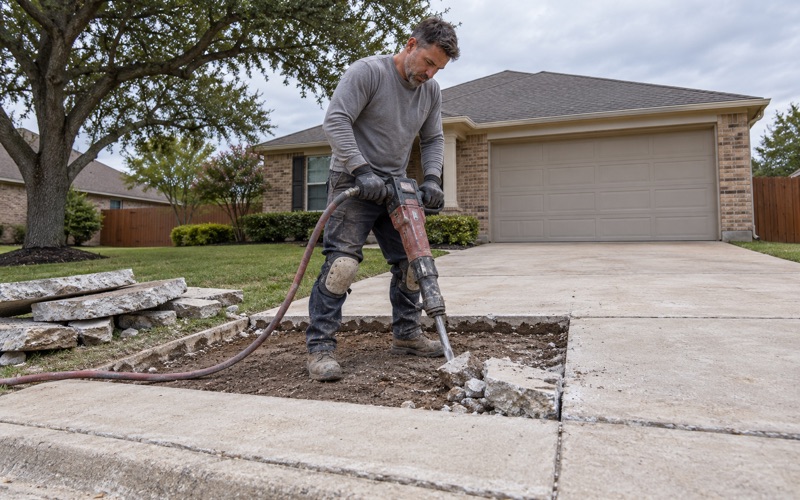
A failed section of concrete driveway being broken out with a hydraulic breaker in Leander, the four inch section and the subgrade showing under it.

Concrete Repair

Crack repair, slab lifting, trip hazard grinding and full replacement for residential and commercial concrete in Leander, TX.

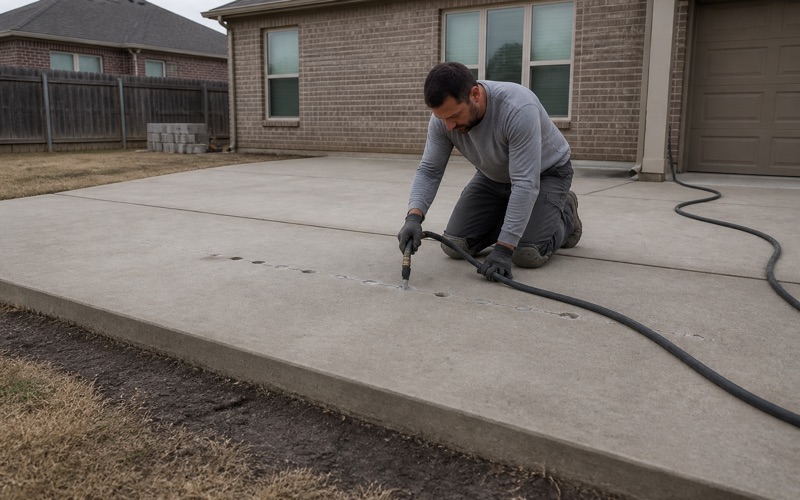
Foam being injected through a drilled port to lift a sunken concrete slab in Leander, the step across the joint still visible.

Concrete Leveling

Foam and slurry lifting for settled driveways, walks, patios and interior slabs across Leander, TX, with the cause fixed first.

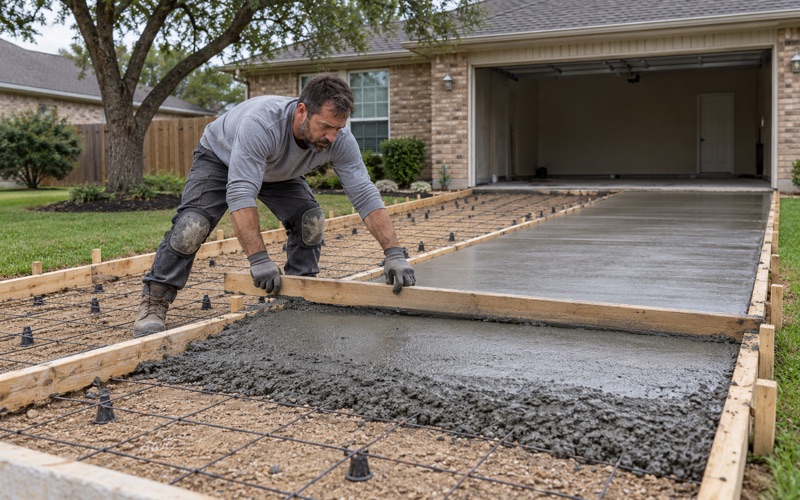
A screed board being drawn across a freshly placed concrete driveway in Leander, struck off flat behind and heaped wet ahead.

Concrete Driveway

New concrete driveways in Leander, TX built to the adopted approach detail, with the permit packet and rock excavation priced up front.

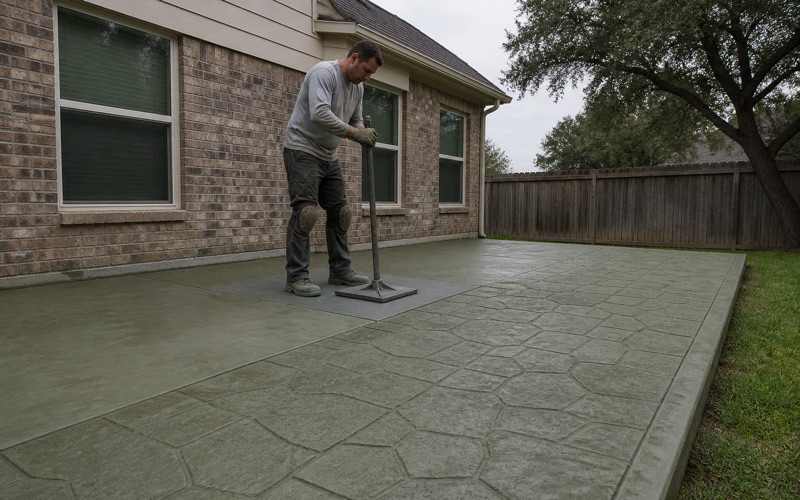
A stamp mat being tamped down into green colored concrete on a Leander patio, the pattern crisp behind it.

Stamped Concrete

Stamped patios, walkways, entries and pool decks in Leander, TX, with color and sealer chosen for how they age outdoors.

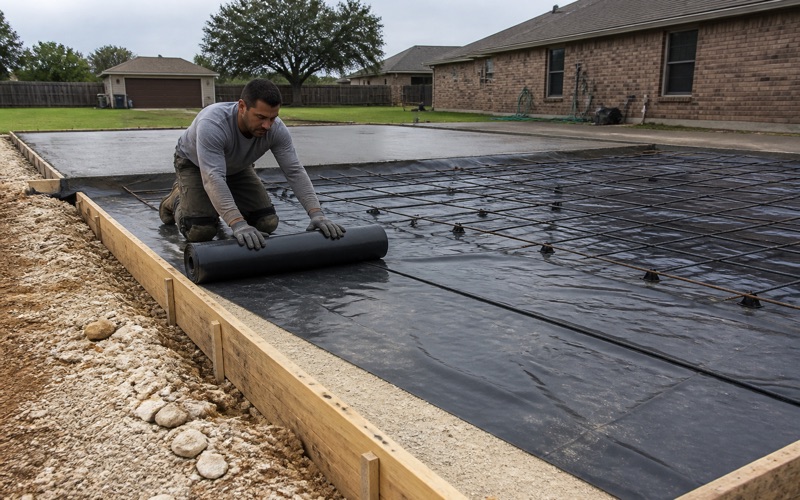
A vapor retarder being rolled out over compacted base for a new concrete slab in Leander, with concrete discharging at the far end.

Concrete Slab

Shop floors, shed pads, RV parking, generator and equipment bases in Leander, TX, built on a verified subgrade.

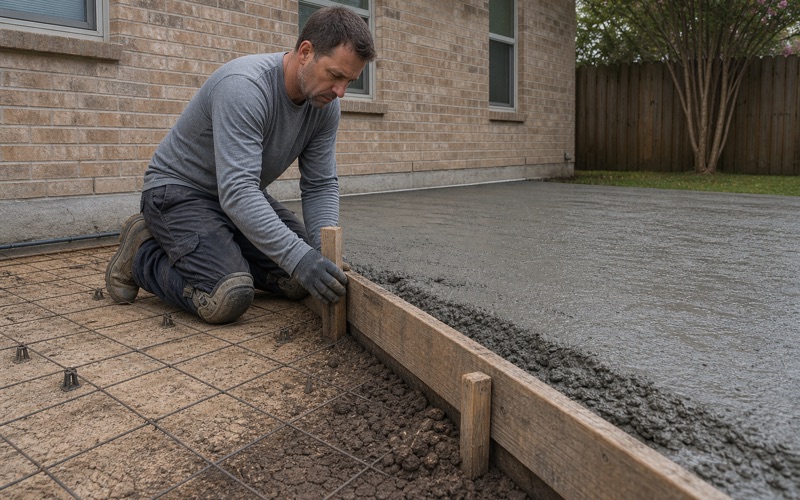
A turndown edge form being set for a new concrete patio in Leander, with concrete placed against the far side of it.

Concrete Patio

Backyard concrete patios in Leander, TX, sized around how you will use them and graded so water leaves the house.

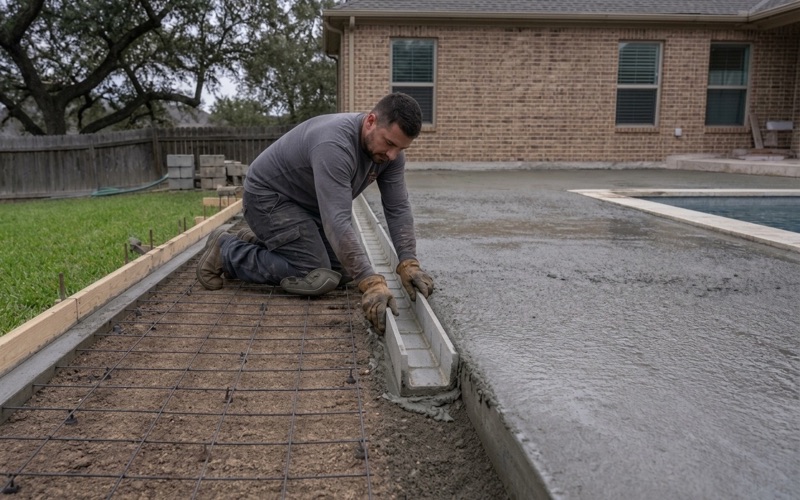
A trench drain channel being set into a new concrete pool deck in Leander, the coping and the placed deck concrete alongside.

Concrete Pool Deck

New and replacement concrete pool decks in Leander, TX, specified for wet grip, summer heat and drainage away from the shell.

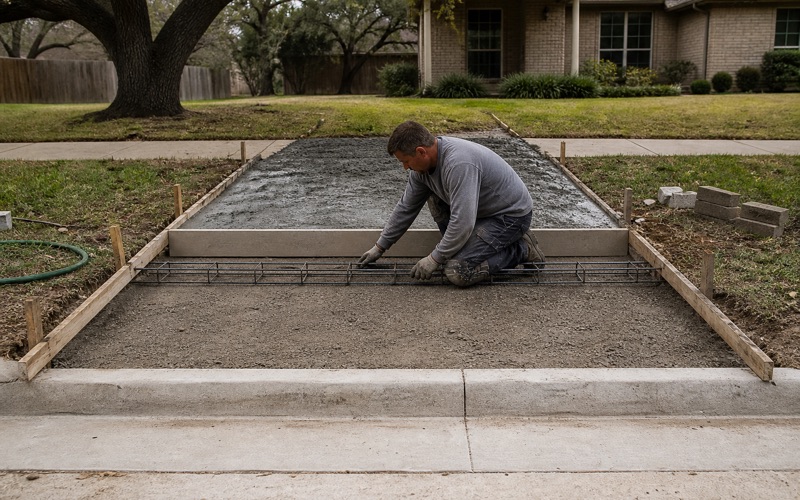
A dowel basket being set in the header of a concrete driveway approach in Leander, with the curb and gutter alongside.

Concrete Driveway Apron

Driveway approaches and aprons in Leander, TX built to the city's adopted detail and slope, permit packet and culvert included.

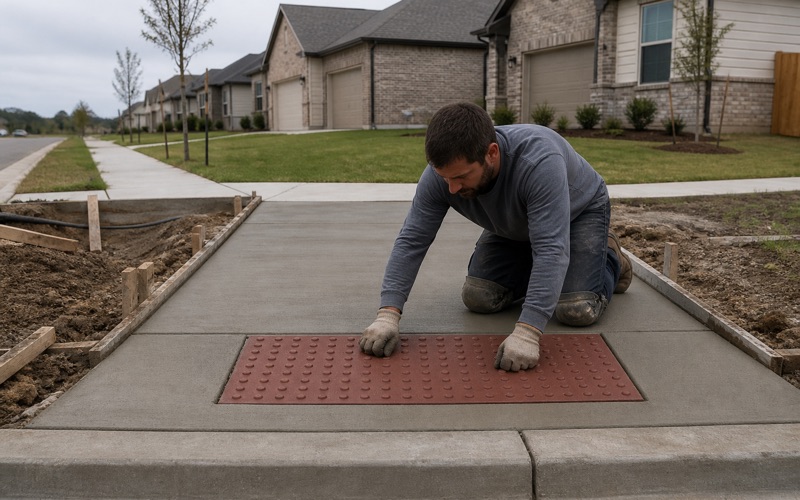
A detectable warning panel being set into a green concrete curb ramp landing in Leander.

Concrete Sidewalk

Front walks, garden paths, public sidewalks and trip hazard repair in Leander, TX, built and jointed to stay level.

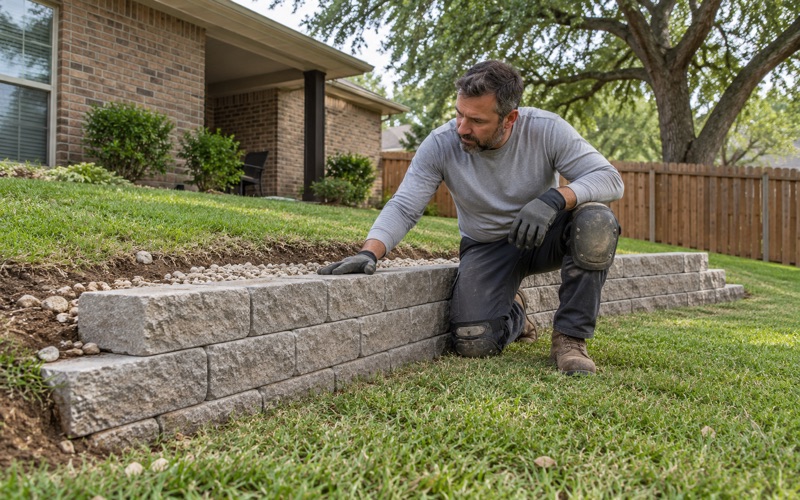
A segmental retaining wall going up course by course on a cast concrete leveling pad in Leander, drainage stone behind it.

Concrete Retaining Wall

Poured concrete retaining, terraced and site walls in Leander, TX, built with real drainage and controlled backfill.

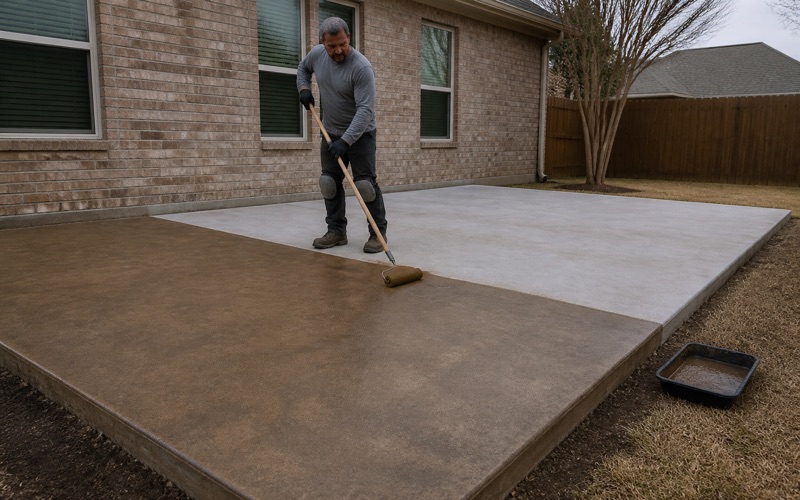
Acid stain being rolled onto a cured concrete patio in Leander, the treated half meeting the untreated half in a clean line.

Decorative Concrete

Stamped, colored, stained, polished and exposed aggregate concrete in Leander, TX, with the sealer and its upkeep quoted up front.

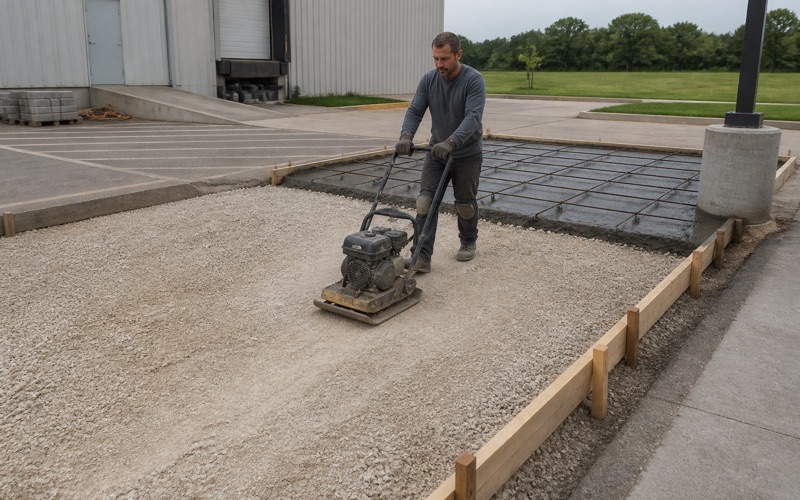
A plate compactor being walked across flexible base for a commercial concrete dumpster pad in Leander, the poured apron alongside.

Commercial Concrete Contractor

Parking lots, curb and gutter, approaches, accessible routes and dumpster pads in Leander, TX, phased around a working site.

Two Decades of Concrete Work in Central Texas

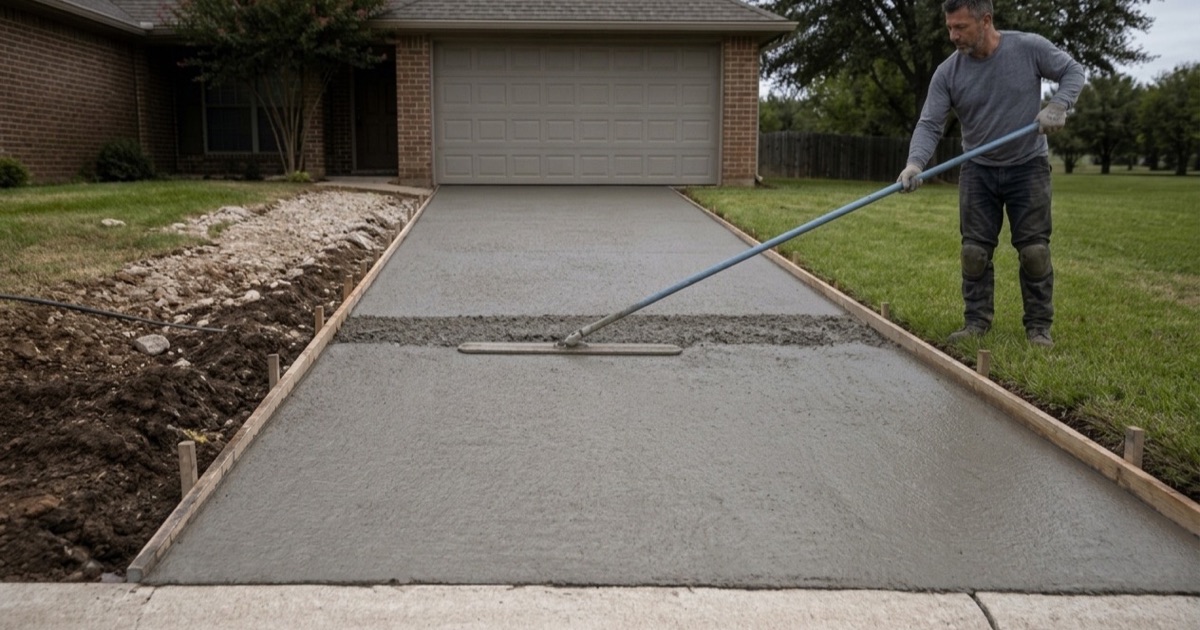
A bull float being pushed out across a freshly placed concrete driveway in Leander, the forms and grade stakes still standing on both sides.

20+ Years Placing Concrete in Leander

We have been building driveways, slabs, flatwork and commercial concrete in and around Leander for over 20 years, which is long enough to have poured on the shallow limestone west of town, the deep shrink swell clay elsewhere, and the calcareous loam in between. That history is why we quote from what is under your particular lot rather than from what the last job in the subdivision cost.

Why Choose Leander Elite Concrete

Permit Packet Prepared for You

Every driveway here needs a Type I residential submittal, and we prepare it: the street accessed, the driveway location and width, the curb radius, the culvert type and size, utilities, easements and any tree over eight caliper inches. A homeowner assembling that alone usually discovers the tree survey requirement after the first rejection, rather than before the clock starts.

Denial Clock Tracked, Not Assumed

Section 3.13.042 inverts the usual deemed approval rule in Leander, so if no notice comes back within ten working days the applicant may assume the permit has been denied. No job of ours reads silence as a yes; we track that clock and follow up inside it, rather than waiting politely while a start date quietly evaporates.

Rock Priced Before We Dig

Blasting is prohibited in Leander and temporary rock crushing is not allowed either, so every foot of limestone on your lot comes out mechanically with a hydraulic breaker or rock saw. We look at the soil map components and the lot itself and price that excavation into the proposal, rather than discovering indurated rock halfway through and returning with a change order.

Steel on Chairs, Inspected Before the Pour

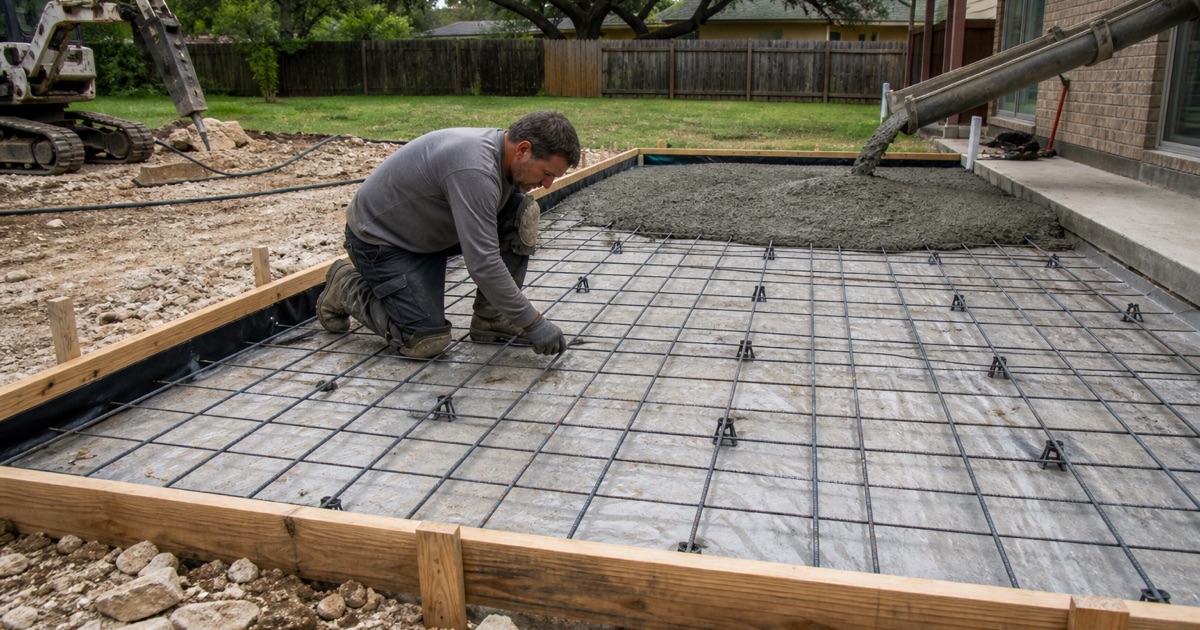
All reinforcing on our jobs sits on rebar chairs, equidistant from top and bottom, never laid on the subgrade or the cushion and walked into place afterward. Steel resting on the ground does nothing for a slab in tension, so we have it inspected before concrete goes in rather than after, when the only remaining evidence is a crack.

Bond Band Named Before You Sign

Every permit under Chapter 3 carries a bond or a cash deposit scaled to the estimated cost of construction, and it reaches ordinary residential work rather than stopping at commercial jobs. We tell you which band your project lands in at proposal time, rather than letting a deposit requirement surface as a delay the week you expected concrete.

New Concrete, and the Ground It Goes On

Reinforcing bar being seated on chairs over a compacted base course, with concrete discharging into the far end of the same formed slab.

What a Concrete Driveway or Slab Job Actually Involves

A concrete job runs from investigating the subgrade through excavation, base, forming, reinforcing, the pour, finishing, jointing and curing, then a wait before the surface takes load. We sequence and schedule all of it in one contract. That matters because the handoffs between excavation, steel and finishing are where most residential concrete work goes wrong.

Why Blasting Is Prohibited on Leander Rock

Leander prohibits blasting outright, and temporary rock crushing is not permitted either, which removes the fast route through limestone that contractors use elsewhere. Every foot of rock comes out mechanically instead. We price that method into the bid from the start, so the excavation line on your proposal is the one you actually pay.

Rock, Caliche and Mechanical Excavation

Indurated limestone and caliche are broken with a hydraulic breaker or cut with a rock saw, both slower and more expensive per yard than digging soil. We measure how much of it sits in your excavation footprint before quoting. Knowing that number in advance is the difference between a fixed price and an open-ended dig.

Three Different Grounds Inside One City

Leander is three excavation problems in one city: shallow rock on the west and south sides, deep shrink swell clay elsewhere, and a nearly inert calcareous loam in between. The same driveway does not cost the same on each. We identify which one your lot sits on rather than transferring a price from the subdivision next door.

Concrete Driveways and the Right-of-Way Line

A driveway crosses from private property into the city right of way, and the two halves are built under different rules. We build the private side to your design and the public side to the City of Austin standard detail Leander adopts. Getting that boundary right is what keeps a finished driveway from failing inspection.

Concrete Slabs and Pads for Shops, RVs and Equipment

Shop floors, shed pads, RV parking, generator pads and equipment bases each carry a different load and need a different thickness, base and reinforcing plan. We size them to what will actually stand on them. A pad poured to driveway thickness under a loaded trailer cracks along the wheel paths within a season.

What Goes Under a Slab Before the Concrete Does

Below the concrete sits compacted subgrade, then flexible base or crusher screenings, then a vapor retarder meeting ASTM E1745 where the slab is enclosed. We verify compaction against a standard Proctor result rather than eyeballing it. Everything above a soft subgrade eventually settles into it, no matter how good the concrete is.

Welded Wire Reinforcement, Rebar and Fiber Mesh

Fiber mesh controls shrinkage cracking in the surface; it does not replace steel carrying load across a crack that has already opened. We use rebar or 6x6 W1.4 x W1.4 welded wire fabric where structural continuity matters and fiber where it genuinely helps. Sold as equivalents, they produce very different slabs five years on.

Post-Tensioned Slab-on-Ground

A post-tensioned slab uses unbonded single strand tendons stressed after the concrete gains strength, designed under PTI DC10.1, and it is the standard answer on expansive clay. We work on and around them, including locating tendons before any cutting. Cutting blind into a stressed slab is dangerous and can release load across the whole panel.

Placing Concrete Through a Central Texas Summer

Heat shortens working time, and a ready-mix load under ASTM C94 has a limited window from batching to placement once it is on the truck. We schedule summer pours early, adjust the mix with a water reducing admixture under ASTM C494 rather than adding water on site, and cure with a membrane curing compound meeting ASTM C309.

When Concrete Cracks, Sinks or Holds Water

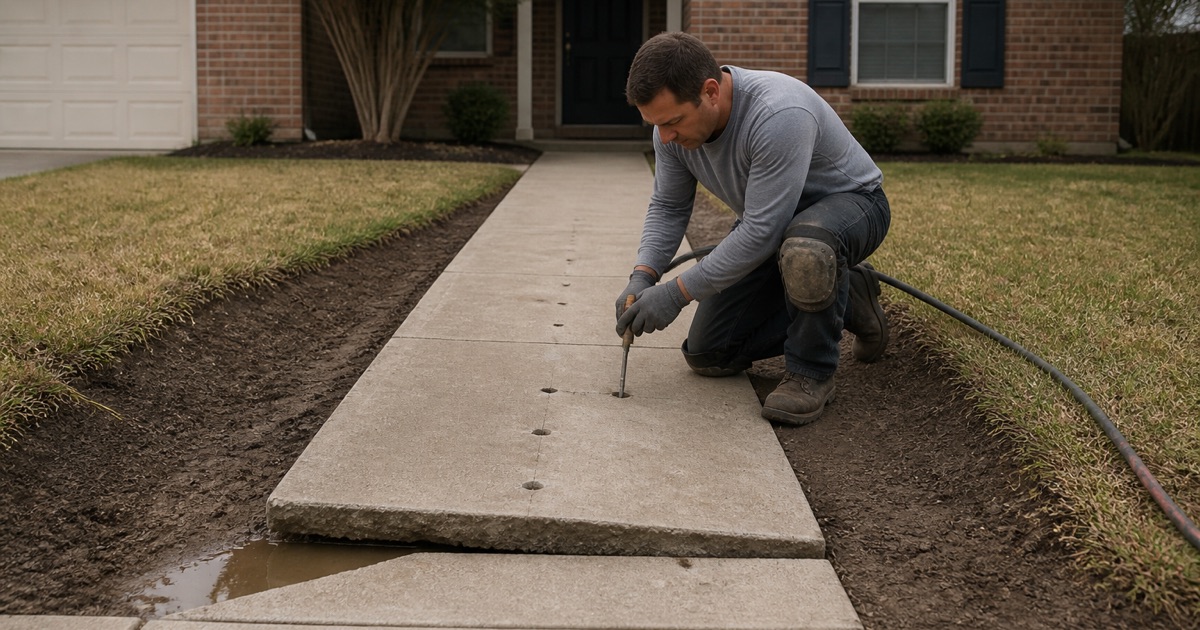
Polyurethane foam being injected through drilled ports into a settled concrete walk in Leander, with water standing along the low side.

Why New Concrete Cracks, and Whose Problem It Is

Concrete shrinks as it cures, and some cracking is expected rather than defective; what matters is width, location and whether it follows a joint. We inspect and tell you which category yours falls into. That answer determines whether it belongs on a builder’s warranty list or is simply how the slab relieved stress.

The One-Year Builder Walkthrough

A new home’s one-year walkthrough is the last easy chance to have concrete defects addressed by the builder. We look at driveways, walks and patios before that window closes and document what we find. Items raised after the walkthrough usually become the homeowner’s expense regardless of when they actually appeared.

What a Control Joint Is For

A control joint, or weakened plane joint, is a deliberate line of weakness that decides where a slab will crack. We cut them with an early-entry saw at the right depth and spacing. A crack running neatly along a sawcut joint is the joint working, not a failure worth paying to repair.

Sinking Slabs and What Is Under Them

A slab that has dropped is almost never a concrete problem; it is a void or a compressible layer underneath, usually from erosion, poor original compaction or clay shrinking away in a dry spell. We investigate the cause before proposing a fix, because lifting a slab over an unresolved void simply buys time.

Slab Lifting: Foam, Mudjacking and Grinding

Polyurethane foam lifting is light and fast, mudjacking is heavier and cheaper per hole, and slab grinding removes the high side instead of raising the low one. Each suits a different slab and a different cause. We recommend by what is under the concrete rather than by which equipment we happen to own.

Why Patching Over a Void Does Not Hold

Filling a surface crack above an unsupported slab section returns the appearance without returning the support, so the patch reopens along the same line. We fill the void first, then repair the surface. A repair that skips the first step is the one homeowners end up paying for twice.

Trip Hazards on Sidewalks and Shared Walks

A vertical offset in a walk is a liability question as much as a maintenance one, and responsibility depends on whether the walk sits on private property or in the right of way. We grind, replace or level it depending on the offset. Documented remediation is what matters after somebody falls.

Standing Water and Grade Running the Wrong Way

Water pooling on a patio or running back toward a foundation is a grade problem, and grade is fixed by replacement or by lifting, not by sealer. We measure fall across the surface before proposing anything. Water directed at a foundation on expansive clay causes far more expensive problems than the flatwork itself.

The Gap Between Driveway and Garage Slab

An isolation joint between a driveway and a garage slab is meant to let the two move independently, and expansion joint filler meeting ASTM D1751 keeps debris out of it. We refill and reseal that joint rather than grouting it solid. Locking two slabs together transfers movement into whichever one is weaker.

When Concrete Repair Is Worth It, and When It Is Not

Repair makes sense when the cause is resolved, the slab is sound and the defect is local; replacement is honest when the base has failed or the surface is broken across most of its area. We tell you which applies. Spending twice on a slab is a decision made at the estimate, not at the repair.

Patios, Pool Decks and Decorative Concrete

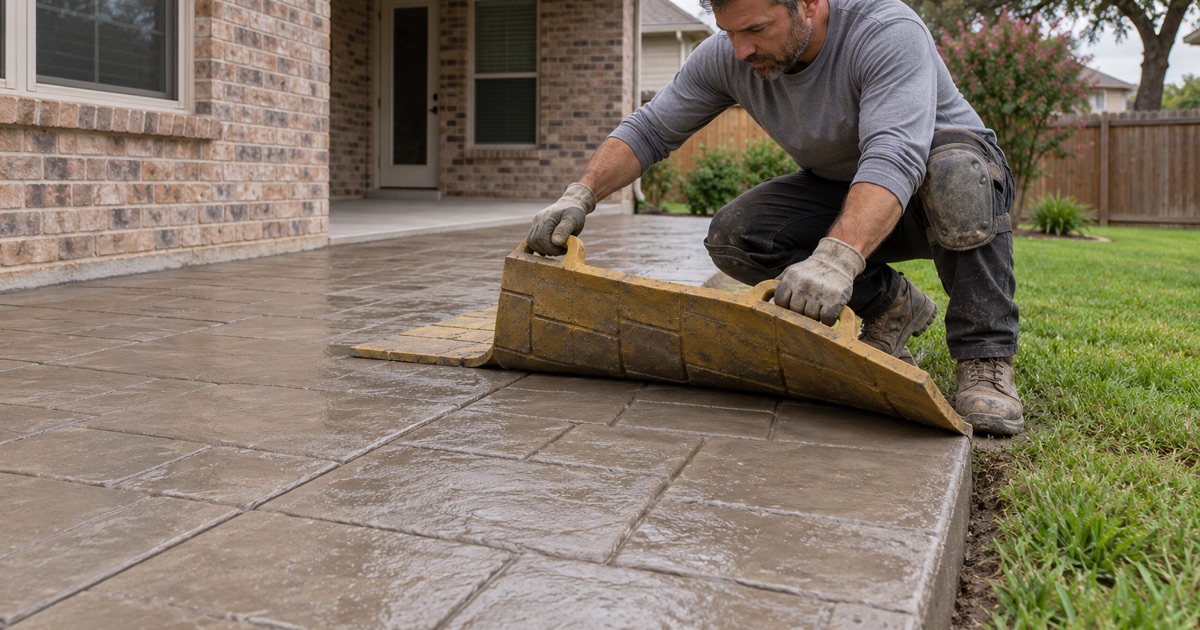
A stamp mat being peeled back off green colored concrete on a Leander patio, the pattern showing behind it.

Stamped Concrete and What a Pattern Really Costs

Stamped concrete prices out as the pattern plus integral color or color hardener, a release agent, and the sealer that keeps it looking like the sample. We quote all four together. A stamped patio bid that excludes sealer is not cheaper, it is simply missing a line you will pay for later.

Choosing Concrete Color That Holds Up Under Texas Sun

Integral color runs through the slab and fades far less visibly than a surface treatment, while acid stain and water-based stain sit at or near the top. We show weathered samples rather than fresh ones. A color chosen from a new chip alone tends to disappoint by the third summer.

Concrete Pool Decks, Slip Resistance and Foot Comfort

A pool deck has to stay grippy wet and tolerable barefoot in August, and those pull in opposite directions: aggressive texture grips and abrades, smooth trowel is comfortable and slick. We choose a broom or salt finish sized to that trade-off. Sealer choice changes slip resistance as much as the finish does.

Broom, Salt, Float and Trowel Finishes

A broom finish gives directional grip for drives and walks, salt finish gives a softer pool deck texture, a float finish is open and matte, and a hard trowel finish belongs indoors. We match finish to use and exposure. A trowel finish outdoors is the most common reason a patio is slick when wet.

Exposed Aggregate and Real Gradation Choice

Exposed aggregate can mean washing the surface paste off a standard mix or specifying the stone under ASTM C33 and designing the look around it. The second costs more and reads far better. We tell you which one a bid describes, because the two are quoted as though they were the same product.

Staining and Dyeing Concrete You Already Have

Acid stain reacts with the concrete itself and water-based stain deposits pigment, and both need a slab that is sound, clean and free of a previous film-forming sealer. We test a hidden area first. A slab contaminated with old sealer or curing residue will take color unevenly no matter how it is applied.

Concrete Sealers and the Reseal Cadence

Penetrating sealers soak in and change appearance little; film-forming sealers add gloss and wear off in traffic paths. Both need renewal on a schedule that rarely comes up during a quote. We tell you the cadence for what we apply, so resealing is a planned cost rather than a surprise.

Matching New Concrete to Older Work

New concrete placed beside older concrete will not match, because cement source, aggregate, age and weathering all differ. We say so before the pour and offer border treatments or an intentional contrast instead. Promising an invisible match is the decorative concrete claim most likely to end in disappointment.

Borders, Bands and Sawcut Patterns

A large pour reads as a slab unless it is broken up, so borders, contrasting bands and sawcut patterns give it scale and hide where joints must fall anyway. We lay out the pattern with jointing requirements rather than against them. Decorative lines fighting control joints produce cracks in the wrong places.

Outdoor Kitchens, Seat Walls and Fire Pit Flatwork

Outdoor kitchens, seat walls and fire pit surrounds all sit on flatwork that has to carry them and drain away from the house. We build the slab and the features as one plan, with isolation joints where masonry meets concrete. Retrofitting a heavy feature onto flatwork poured without it cracks the slab.

Driveway Permits, Approaches and Commercial Work

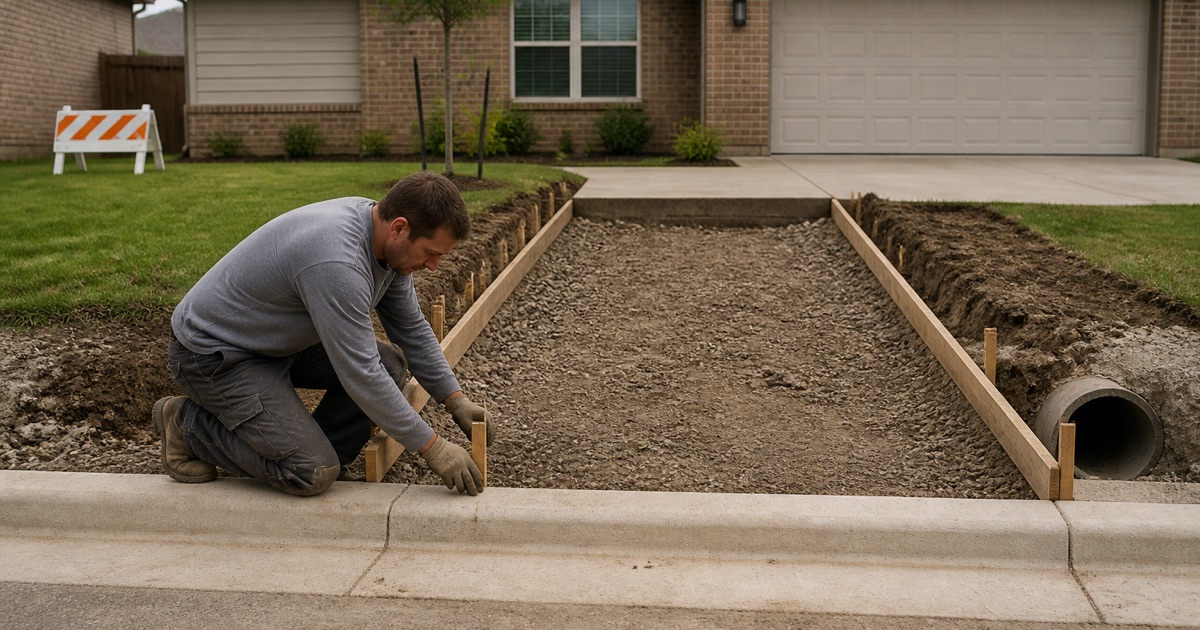
A driveway approach being formed at the curb in Leander, the forms set to a uniform slope inside the right of way.

The Leander Driveway Permit and Its Submittal Packet

A driveway in Leander requires a plan reviewed permit rather than a counter transaction, and the Type I residential submittal shows the street accessed, the driveway location and width, the curb radius, culvert type and size, utilities, easements and trees over eight caliper inches. We prepare and submit that packet as part of the job.

Why Silence From the City Counts as a Denial

Under Section 3.13.042, if no notice comes back within ten working days the applicant may assume the permit has been denied, which is the reverse of the deemed approval rule most people expect. We track that clock rather than reading silence as approval, because assuming a yes here is how a start date is lost.

The Construction Bond and the Cash Deposit

Every permit issued under Chapter 3 carries a bond or a cash deposit scaled to the estimated cost of construction, and it reaches ordinary residential work rather than only commercial projects. We identify the band your job falls into before you sign. We also carry the public liability and property damage insurance the city requires on bonded work.

Culvert Pipe and the Safety End On It

Where a driveway crosses a ditch, a culvert carries the flow and a safety end protects the exposed pipe, built to Leander standard details 202-2 and 202-3. Sizing follows the drainage, not the driveway width. We size and detail both in the submittal, because an undersized culvert is rejected at review or fails later.

Driveway Approaches, Aprons and the Two Percent Slope

Every approach carries a uniform two percent slope inside the right of way, and we build residential to COA 433S-1 and commercial to COA 433S-2 as drawn. Water standing at the street is the one defect the city makes a contractor rebuild at its own expense, so the slope is set and checked before the pour.

Driveway Connections in the Leander ETJ

In the Leander extraterritorial jurisdiction most city permits fall away, but a driveway connection remains one of the few still required. We confirm which side of that line a property sits on before starting. Assuming a rural address is unregulated is how an otherwise finished driveway ends up needing after-the-fact approval.

Site Development Permits and Commercial Concrete

Commercial work crosses into site development review, which brings drainage, paving sections and accessibility into the same submittal rather than treating them as separate jobs. We build commercial flatwork and paving to those approved plans, and we keep an updated contractor registration on file with Leander Building Permits and Inspection, which the city requires and charges nothing for.

Parking Lots, Curb and Gutter, Wheel Stops and Bollards

A parking lot is pavement, COA 430-2 reinforced curb and gutter, striping, wheel stops and bollards protecting what vehicles reach. We build the section and the protection together. Bollards added after a storefront has already been struck cost more than the ones designed into the original layout.

Accessible Routes, Curb Ramps and Barriers Review

An accessible route needs curb ramps, running and cross slopes within tolerance, and a detectable warning surface at the street, following PROWAG. Larger commercial projects also trigger TDLR architectural barriers review. We build to those tolerances and verify with a level, since a ramp a fraction out of range fails inspection and gets replaced.

Dumpster Pads and Loading Areas

A dumpster pad takes a front-loading truck’s concentrated axle load and the abrasion of a steel container dragged across it, so it is a thicker, more heavily reinforced slab than the parking around it. We build pads and loading areas to that duty. A pad poured to lot thickness fails at the container corners first.

Concrete Work Kept to Approved Hours

We work the hours the approved plans allow, which means nothing overnight and nothing on a weekend without the inspector’s approval arranged four days ahead. On a commercial reconstruction we keep at least half the driveway open at all times. That is what the specification requires and what keeps your tenants trading while the work runs.

Areas We Serve

Leander Elite Concrete provides concrete-contractor throughout the greater Leander area, with the same crews and the same standards on every job.

Good to know

Frequently Asked Questions

How much does a concrete driveway cost in Leander?

Price is driven mostly by what is under the lot rather than by square footage. Leander spans shallow rock on the west and south sides, deep shrink swell clay elsewhere and calcareous loam in between, and mechanical rock excavation costs far more per yard than digging soil. Thickness, reinforcing, finish and whether a culvert is involved move it further, which is why we look at the lot before quoting.

Do I need a permit for a driveway in Leander?

Yes. A driveway here is a plan reviewed permit rather than a counter transaction. The Type I residential submittal has to show the street accessed, the driveway location and width, the curb radius, culvert type and size, utilities, easements and trees over eight caliper inches. We prepare and submit that packet as part of the work rather than leaving it with the homeowner.

How long does a concrete project take from first call to finished slab?

The concrete itself is usually the shortest part. Plan review, the bond or deposit, excavation and forming all come first, and Section 3.13.042 means a permit is treated as denied if nothing comes back within ten working days, so we track that clock. Once placed, an approach is barricaded for the four days after the pour and opens when the engineer approves it.

Are you registered and insured to work in Leander?

We keep an updated registration on file with Leander Building Permits and Inspection, which the city requires of every general contractor and subcontractor and charges nothing for. We also carry the public liability and property damage insurance required before a bonded project starts: one hundred thousand dollars for one person, three hundred thousand for two or more, and one hundred thousand for property in any one accident.

What is the construction bond, and does it apply to a house?

Every permit issued under Chapter 3 carries a bond or a cash deposit scaled to the estimated cost of construction, and it reaches ordinary residential work rather than stopping at commercial jobs. The amount depends on which band your project's estimated cost falls into. We tell you that band at proposal time, so it is part of the decision rather than a delay discovered later.

Can you blast or crush rock on my lot to speed up excavation?

No. Blasting is prohibited outright in Leander and temporary rock crushing is not allowed either, so every foot of limestone comes out mechanically with a hydraulic breaker or a rock saw. That is slower and more expensive per yard, which is exactly why we assess the rock in your excavation footprint and price it into the proposal instead of raising it midway through.

What concrete mix do you use on a driveway approach?

The specification prescribes it rather than leaving it to the contractor. Item 433S calls for Class A concrete under Section 403.7 of Item 403 on a Type I driveway, and a normal concrete pavement mix under Section 360S.5A on a Type II. We place the mix the detail requires and control slump and water-cement ratio rather than adding water on site to make placing easier.

Is rebar or fiber mesh better for a slab?

They do different jobs and are not substitutes. Fiber mesh reduces shrinkage cracking in the surface, while rebar or welded wire reinforcement carries load across a crack once it has opened. We specify by what the slab has to do, and any steel we place sits on chairs equidistant from top and bottom and is inspected before the pour rather than after.

How soon can I drive on new concrete?

Later than the surface suggests. Concrete is hard to the touch long before it has gained the strength to carry a vehicle, and the specification barricades a new approach for the four days after placing, opening it when the engineer approves rather than when it looks ready. We give you a date for your specific pour and cure it properly rather than shortening the wait.

Do you repair concrete, or only replace it?

Both, and we will tell you which one your slab justifies. Repair is right when the underlying cause is resolved, the slab is sound and the defect is local. Replacement is the honest answer when the base has failed or the surface is broken across most of its area. Lifting or patching a slab over an unfilled void only buys a little time.

Ready to Get Started?

Request a free quote today and we'll get back to you fast.