
Leander Elite Concrete builds concrete sidewalk and walkway projects in Leander, TX and nearby cities including Brushy Creek, Round Rock, Cedar Park, Wells Branch and Pflugerville, with more than 20 years of flatwork experience across Central Texas. Walks are small pieces of concrete that get looked at constantly, walked on daily and judged immediately, which makes execution matter more than the material cost suggests.
They also fail differently from larger slabs. A walk is narrow, so it has little capacity to bridge a soft spot, and it usually runs alongside the things that undermine it: tree roots, downspout discharge, irrigation and utility trenches. We look at the whole run and what is under it rather than pricing linear feet of concrete.
Front Walks, Paths and Garden Routes
Route, Width and How People Actually Walk
We lay out walks along the line people already take rather than the line that looks tidy on a plan, and we size them for real use: two people side by side on a front walk, a stroller or a wheelchair where that matters, clearance from planting that will grow. The route gets marked on the ground before forming, which is the last moment changing it is free.
Curves, Steps and Changes in Level
Where ground falls, a walk becomes steps and landings, and consistent riser heights matter far more for safety than the finish does. We keep risers uniform across every flight and make landings large enough to stand on comfortably. A single odd riser in an otherwise even run is the one people trip on, precisely because the rest of the flight taught them what to expect.
Finishes, Grip and Decorative Detail
A broom finish across the direction of travel gives dependable grip on a walk, and decorative options such as integral color, stamped patterns, exposed aggregate and sawcut borders all work well at this scale. What we avoid on a walking route is a smooth or high-gloss surface that becomes slick in rain. Grip is a safety specification on a walk, not a style preference.
Public Sidewalks and the Right of Way
Work Inside the Right of Way
A sidewalk in the public right of way is permitted work built to an adopted standard rather than a private slab you can specify freely, and we build those to the COA 432S-1 sidewalk detail Leander adopts. We confirm which side of the property line your walk sits on before quoting. That determination changes the specification, the permitting and who has to approve the finished work.
Accessible Routes, Slopes and Detectable Warnings
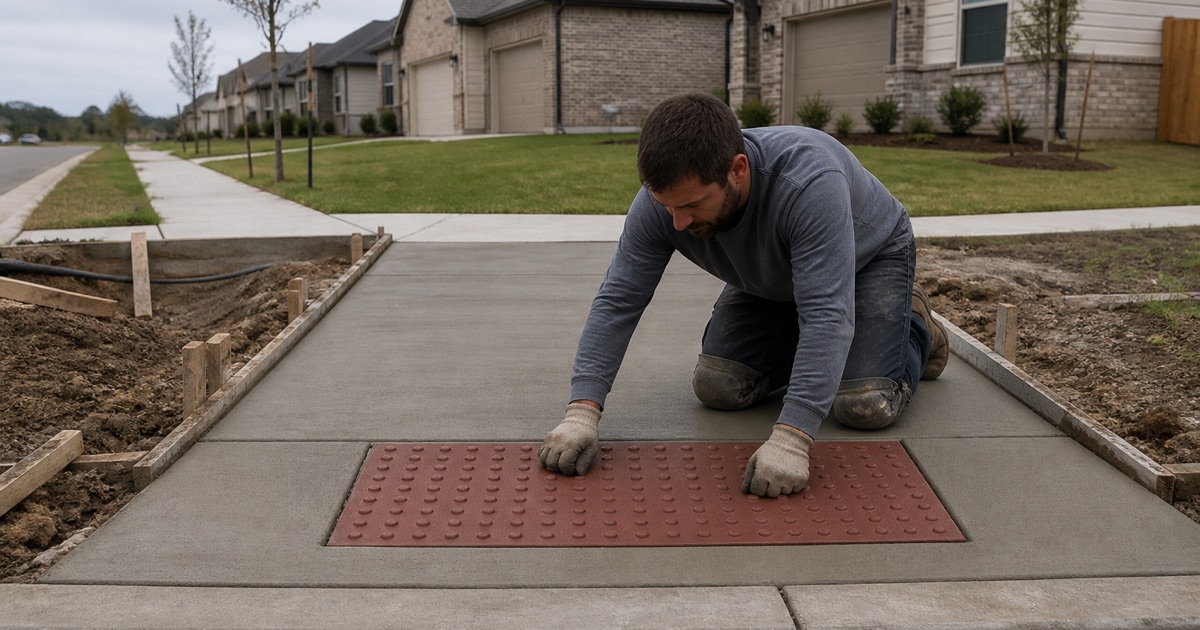
An accessible route has to hold its running slope and cross slope within tolerance, with curb ramps and a detectable warning surface where it meets the street, following PROWAG. We survey with a level rather than judging by eye, because a ramp a fraction outside tolerance fails inspection and gets replaced. Larger commercial projects can also trigger TDLR architectural barriers review.
Driveway Crossings and Changes in Section
Where a walk crosses a driveway it stops being a pedestrian slab and starts carrying vehicles, so the thickness and reinforcing change even though the surface reads as continuous. We build that transition to the heavier section rather than running walk thickness across it. A walk poured at uniform thinness through a driveway crossing breaks up exactly where the wheels track.
Repair, Leveling and Trip Hazards
Grinding Small Offsets
A modest vertical offset between panels can be ground to a compliant slope in a single visit, which is the cheapest genuine fix available and removes the hazard without disturbing the run. We use it where the offset is small enough that grinding does not leave a visible dish. Beyond that point grinding stops being a repair and starts being a different defect.
Lifting Settled Panels
Where a panel has dropped rather than merely lipped, lifting returns the whole run to plane and, done properly, fills the void that let it settle. We find the cause first, whether that is erosion, a utility trench that was never compacted or clay shrinking away in a dry spell. Lifting without filling the void produces a level walk that settles again on the same schedule.
Replacing Broken Panels and Root Damage
Panels broken into pieces that rock underfoot, or heaved and cracked by tree roots, are replacement work rather than repair work. We deal with the root cause where it is possible to do so without killing the tree, and adjust the alignment or the section where it is not. Replacing a root-damaged panel while leaving the root untouched simply schedules the same failure again.
What Goes Under a Walk
Subgrade, Base and Compacted Backfill
Narrow slabs cannot bridge soft ground, so we compact the subgrade, place base to the specified depth and pay particular attention to any utility trench the walk crosses, since trench backfill is the single most common source of settlement under a run. Where limestone has to come out it comes out mechanically, because blasting is prohibited in Leander and temporary rock crushing is not permitted.
Jointing and Panel Length
Joint spacing does more for a walk than reinforcing does, so we cut control joints on a spacing matched to the width and thickness, with isolation joints where the walk meets a driveway, a step, a foundation or a wall. Panels left too long crack in the middle, and a crack across a narrow walk is far more visible than the joint that would have prevented it.
Drainage and Keeping Water Off the House
A walk running alongside a house is also a small drainage structure, and one falling the wrong way delivers roof and irrigation water straight to the foundation. We set cross fall away from the structure and make sure the walk does not dam water against a wall or a planting bed. On shrink swell clay that detail matters well beyond the concrete it is built into.
- 20+ Years in Concrete
- Licensed & Insured
- Free Estimates